
The Distribution Manifesto
Chapter 10 of 11 · 19 min read
Build, Buy, Agency, or Hybrid
Choosing the Right Distribution Operating Model
The argument
The build-versus-buy question is usually asked too late and too narrowly.
Teams ask it after they already feel the pain: paid media is expensive, organic output is inconsistent, creator partnerships are hard to scale, content production is fragmented, and campaign reporting does not tell them what to do next. By then, the question often becomes tactical:
Should we hire someone, contract an agency, or use a platform?
That is the wrong first question.
The correct question is:
What distribution operating model should this company own, rent, partner for, or outsource at this stage of maturity?
Creator-Powered Distribution is not one workflow. It is a system that coordinates source content, packaging, creator supply, incentives, workflow, governance, measurement, and capital allocation. That system can be assembled internally, accessed through a platform, delegated to an agency, or operated through a hybrid model.
Each path can be correct. Each path can also fail.
I learned the distinction by trying to sell the wrong layer first.
During Clipur's first month, we tried to sell access to the product. We sold none. When we sold managed execution instead, weekly revenue made an immediate, roughly tenfold jump.
That did not prove software was unnecessary. It proved the software had not yet captured the operational judgment the buyer needed. The customer was not shopping for a dashboard. The customer wanted the campaign launched, the right clippers activated, the submissions reviewed, the client kept informed, and the result explained.
At that point, the team was acting as product managers, developers, backend operators, customer support, sales, marketing, and campaign managers at the same time. The service was carrying the knowledge the product had not yet encoded.
This is a common mistake in build-versus-buy discussions: comparing a tool with a managed outcome as if they are the same unit. They are not. The correct question is where the judgment, supply, workflow, and accountability live today—and which parts can become dependable infrastructure tomorrow.
Building can create a durable capability but hide enormous management cost. A platform can compress time to value but cannot replace strategy. An agency can provide judgment and execution but may keep the learning. A hybrid can combine control and leverage but fails when ownership is vague.
The core argument of this chapter is:
Distribution infrastructure should be evaluated as an operating-model decision, not a vendor-procurement decision.
A company should not ask only, “Which option is cheaper?” It should ask:
- Which option produces qualified attention fastest?
- Which option creates reusable assets?
- Which option improves future campaigns?
- Which option gives us the right amount of strategic control?
- Which option creates the lowest total cost of distribution ownership?
- Which option gives us data we can use again?
- Which option lets us scale without increasing operational fragility?
- Which option creates Creator Capital rather than one-off output?
The right answer depends on maturity, urgency, volume, governance risk, internal talent, source-content strength, creator-network requirements, measurement needs, and strategic centrality.
Build versus buy is not binary.
It is a portfolio decision about what to own, what to rent, what to outsource, what to standardize, and what to keep close.
What the product taught me not to automate
Early in the build, I wanted payouts to feel instant.
Then we worked through what “instant” actually meant. A brand could approve a clip while its views were still rising. If we paid immediately, the system would either underpay the creator, issue repeated payments, or guess at a final number. At the time, we were still checking performance manually every day.
I said something in that product meeting that I still believe:
As much as I want instant, there is a reason instant does not exist here yet.
We chose a final tally after the campaign or payout cap rather than pretending speed was the same as correctness.
That did not make me anti-automation. In another workflow review, we found that replacing a multi-step funding process with one submit-and-pay action could remove an estimated 20–30% of the administrative work. That was exactly the kind of automation worth building: a repeated action with a clear state change, known rules, and an obvious customer benefit.
The distinction is judgment.
Automate copying, validation, routing, reminders, calculation, deduplication, and obvious rule enforcement as quickly as the data allows. Preserve human review where money, fraud, rights, brand risk, unclear context, or costly exceptions determine the answer.
By July, the self-serve product plan had expanded into automated intake, brief generation, payment, launch, reporting, and renewal. We still kept a lightweight review step before a new campaign went live.
The goal was never to remove humans from the system. The goal was to stop wasting humans on work the system already understood.
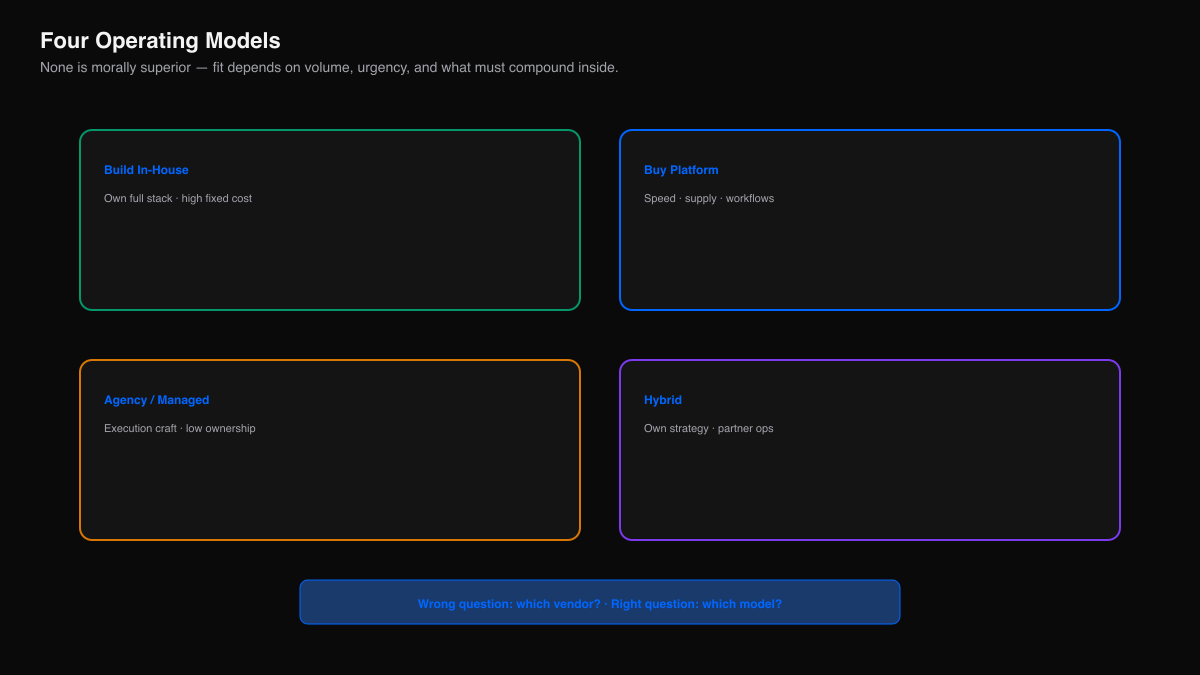
The Four Distribution Operating Models
A Distribution Operating Model is the organizational structure through which a company plans, launches, governs, measures, and improves creator-powered distribution.
There are four primary models.
- Build in-house.
- Buy through a platform or infrastructure partner.
- Hire an agency or managed-service provider.
- Operate a hybrid model.
These models are not moral categories. One is not more sophisticated in all cases. The right model depends on fit.
Model 1: Build In-House
In the in-house model, the company owns the operating system directly.
It hires or assigns internal talent to manage source-content intake, clip strategy, creator recruitment, creator onboarding, campaign briefs, payout rules, approval workflow, measurement, benchmark governance, and reallocation decisions. It may still use software tools, contractors, or freelancers, but the company itself owns the operating capability.
This model is most appropriate when distribution infrastructure is strategically central to the company.
Examples:
- A media company where distribution is the product.
- A founder-led brand with constant source content and high urgency around audience growth.
- A marketplace where creator distribution is tied to supply acquisition.
- A regulated company where claims, compliance, and data control require close governance.
- A large brand with enough campaign volume to justify permanent operating headcount.
The advantage of building in-house is control.
The company can build proprietary data, creator relationships, brand-specific operating standards, internal benchmarks, and cross-functional learning. Over time, this can become a real moat.
The disadvantage is time and hidden cost.
An internal team must solve several problems at once:
- Hiring.
- Creator acquisition.
- Creator vetting.
- Creator retention.
- Workflow design.
- Legal and compliance review.
- Payout rules.
- Source-content operations.
- Performance reporting.
- Benchmark creation.
- Fraud and integrity controls.
- Creative feedback loops.
- Tooling integration.
Most companies underestimate the cold-start cost of creator supply. They assume creator distribution is mostly content production. It is not. It is network operations.
The company does not merely need someone who can cut clips. It needs a system that can source, activate, evaluate, retain, and improve creator nodes.
Building in-house is attractive when the company has enough distribution volume to amortize those costs. It is dangerous when the company wants infrastructure-level outcomes without infrastructure-level investment.
Model 2: Buy Through a Platform or Infrastructure Partner
In the platform model, the company accesses an external infrastructure layer.
A platform like Clipur can provide creator supply, campaign workflow, incentive management, submission systems, approval rails, payout coordination, reporting structure, benchmark architecture, and repeatable execution patterns. The customer supplies business context, source content, claim rules, brand standards, objectives, budget, and review authority.
This model is most appropriate when the company needs speed, creator liquidity, operational standardization, or benchmark learning before it commits to internal buildout.
The advantage of buying is time compression.
The buyer avoids building the entire infrastructure layer from scratch. Instead of creating creator supply, workflow, payout logic, measurement conventions, and campaign governance independently, the buyer starts from an existing operating environment.
This matters because Creator-Powered Distribution is bottleneck-sensitive. A weak creator network, slow approval process, unclear brief, or missing measurement layer can break the entire flywheel.
The platform model can reduce the cold-start problem by giving the buyer access to:
- Existing creator-network liquidity.
- Existing campaign workflows.
- Standardized campaign objects.
- Repeatable approval and reporting cadence.
- Payout and incentive infrastructure.
- Comparative benchmark context.
- Faster launch cycles.
- Operational expertise from prior campaigns.
The disadvantage is dependency risk.
If the company outsources too much judgment, it may not build its own strategic muscles. If data is not portable, benchmark definitions are unclear, or reporting is too high level, the company may become dependent without becoming smarter.
The platform model is strongest when the buyer treats the platform as an execution and infrastructure partner, not as a replacement for strategy.
The company should still own:
- Positioning.
- Source-content strategy.
- Claim library.
- Brand standards.
- Target customer definition.
- Qualification rules.
- Budget logic.
- Business outcome definitions.
- Internal benchmark interpretation.
The platform can run infrastructure. It should not become the only place where institutional knowledge lives.
Model 3: Hire an Agency or Managed-Service Provider
In the agency model, the company delegates strategy, creative direction, campaign management, or production to an external services team.
This model is most appropriate when the company needs judgment, craft, or managed execution more than infrastructure liquidity.
Agencies can be useful when:
- The brand needs a strategic campaign concept.
- The company lacks creative direction.
- Messaging is underdeveloped.
- The company needs hands-on production support.
- The campaign is bespoke rather than repeatable.
- Senior stakeholder management is required.
- The company wants service-heavy support rather than platform-heavy execution.
The agency model can work well for high-touch strategy and content development.
It is weaker when the company needs repeatable networked distribution infrastructure. Traditional agency economics are usually labor-based. That can create a mismatch: the buyer needs a compounding distribution system, while the provider sells hours, retainers, project work, and campaign deliverables.
This does not make agencies bad. It means the buyer must distinguish service output from infrastructure output.
A good agency engagement may produce excellent creative, better briefs, stronger positioning, and campaign-ready assets. But the buyer should ask:
- Do we retain the benchmark data?
- Do we retain the performance taxonomy?
- Do we retain creator cohort learnings?
- Do we retain reusable asset libraries?
- Do we retain approval and claim standards?
- Do we retain distribution operating knowledge?
- Do we improve our next campaign, or do we need the same agency to rediscover the same lessons?
Agency work becomes infrastructure only when the learning, data, templates, and operating standards survive the engagement.
Model 4: Operate a Hybrid Model
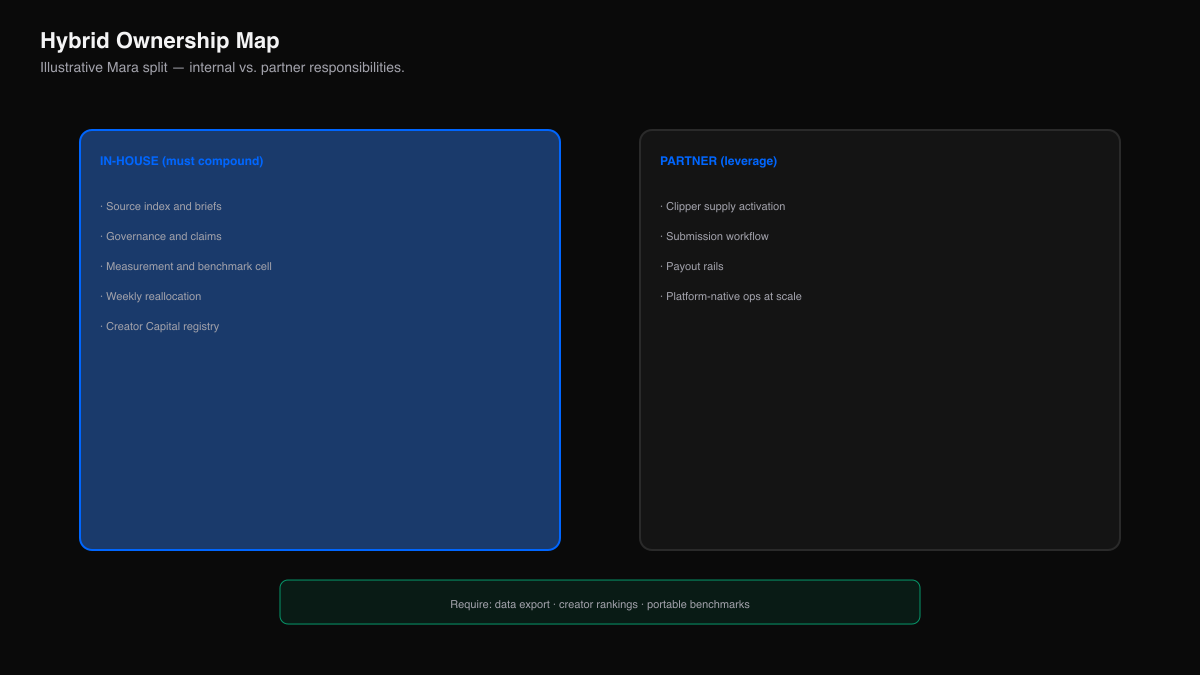
In the hybrid model, the company owns strategic control and governance while using external partners for infrastructure, creator supply, workflow, or specialist execution.
This is often the best model for companies that are serious about distribution but not ready to build every component internally.
A strong hybrid model divides ownership clearly.
| Company Owns | Partner Provides |
|---|---|
| Positioning | Creator supply |
| Source-content strategy | Campaign workflow |
| Claim rules | Submission infrastructure |
| Audience definition | Payout and incentive rails |
| Qualification rules | Operational reporting |
| Budget logic | Creator activation support |
| Business outcomes | Benchmark context |
| Governance standards | Execution cadence |
| Internal learning repository | Platform/process leverage |
Hybrid works because it avoids two failure modes.
It avoids the in-house cold start, where the company spends months building operational capacity before it produces useful distribution output.
It also avoids passive outsourcing, where the company buys campaigns but fails to build institutional capability.
The hybrid model is the likely default path for many serious operators:
- Start with external platform execution.
- Learn campaign economics and operational requirements.
- Build internal governance, source-content operations, and benchmark interpretation.
- Decide which functions should be internalized.
- Keep external leverage where liquidity, tooling, or execution scale remains superior.
The hybrid model is not a compromise. Done correctly, it is a staged capability-building strategy.
The Distribution Operating Model Matrix
The Distribution Operating Model Matrix compares the four operating models across the dimensions that matter most.
| Dimension | Build In-House | Platform / Infrastructure Partner | Agency / Managed Service | Hybrid |
|---|---|---|---|---|
| Speed to value | Slowest unless team already exists | Fastest when source content and governance are ready | Medium; depends on scope | Fast after operating roles are defined |
| Creator supply | Must be built or acquired | Existing network liquidity | Depends on agency network | External supply plus internal learning |
| Strategic control | Highest | Medium to high if governance retained | Medium; can drift if agency owns strategy | High when roles are clear |
| Data ownership | Highest if instrumented well | Depends on platform exports and definitions | Often weak unless contracted | Strong if portability is required |
| Governance control | Highest | Shared | Shared or delegated | High with explicit approval ownership |
| Benchmark quality | Slow to build | Stronger if platform has cross-campaign data | Often project-specific | Strong if external benchmarks plus internal history combine |
| Talent requirement | Highest | Lower | Lower to medium | Medium |
| Management overhead | High | Medium | Medium to high | Medium |
| Customization | Highest | Medium | High for bespoke campaigns | Medium to high |
| Scalability | High after buildout | High if platform liquidity holds | Limited by service capacity | High if operating cadence is clean |
| Switching risk | Low if internally owned | Depends on data portability and process lock-in | Depends on knowledge transfer | Lower if internal control layer is maintained |
| Best fit | High-volume strategic capability | Speed, liquidity, pilots, scale | Bespoke strategy and production | Serious operators building capability over time |
This matrix should not be used as a generic scorecard. It should be weighted by company situation.
A regulated healthcare brand should weight governance more heavily than speed.
A fast-growing consumer app may weight speed, creator supply, and learning rate more heavily than customization.
A founder-led education company may weight source-content leverage, reusable asset production, and creator network fit.
A large enterprise may weight procurement, data portability, compliance, and reporting standards.
The matrix is useful because it surfaces trade-offs before a team commits.
The most common mistake is to optimize for the dimension that is easiest to see.
Price is easy to see.
Time to launch is easy to feel.
Headcount is easy to count.
But the hidden dimensions often decide whether the operating model works: creator liquidity, approval latency, data portability, benchmark quality, internal learning capture, and governance reliability.
The Build-vs-Buy Decision Tree
The Build-vs-Buy Decision Tree is the practical routing system for choosing the right model.
Start with strategic centrality.
Step 1: Is distribution infrastructure strategically central?
Ask:
- Does distribution directly affect the company’s moat?
- Will distribution performance materially change company valuation?
- Does the company produce enough source content to justify a standing system?
- Is creator-powered distribution a core growth channel rather than a side experiment?
- Would proprietary creator, content, and benchmark data become a long-term advantage?
If the answer is no, do not build the full infrastructure internally.
Use a platform, an agency, or a limited hybrid model.
If the answer is yes, continue.
Step 2: Is there enough repeatable volume?
Ask:
- Will the company run creator-powered campaigns every month or quarter?
- Is there a recurring source-content engine?
- Are there multiple products, offers, audiences, markets, or content themes to test?
- Can the company create enough distribution events to justify benchmarks?
- Is there enough expected spend to amortize internal team cost?
If volume is low, buying or agency support is usually better.
If volume is high, building or hybrid becomes more plausible.
Step 3: Does the company have internal operating maturity?
Ask:
- Is there a clear owner for distribution operations?
- Can the company produce campaign briefs reliably?
- Can it define qualified views and qualified outcomes?
- Can it review assets quickly?
- Does it have claim governance?
- Does it have analytics capacity?
- Does it have budget reallocation authority?
If internal maturity is low, do not build from scratch. Start with a platform or hybrid model.
If internal maturity is high, building becomes viable.
Step 4: How urgent is speed to value?
Ask:
- Does the company need market feedback immediately?
- Is there a launch window?
- Is the company currently overdependent on paid media?
- Is organic growth stalled?
- Is the company trying to prove a new channel before hiring?
If urgency is high, buying or hybrid is usually better.
If urgency is low and long-term strategic control is high, internal buildout can be justified.
Step 5: How sensitive are claims, compliance, and brand risk?
Ask:
- Are creators making regulated claims?
- Are testimonials, performance claims, health claims, financial claims, or earnings claims involved?
- Is brand safety risk high?
- Are approvals legally sensitive?
- Is data privacy or customer information involved?
If risk is high, the company must own the governance layer even if it buys execution.
High risk does not always mean build everything internally. It means retain strong control over claim libraries, red/yellow/green claim zones, approvals, disclosures, data access, and escalation rules.
Step 6: Which assets must be portable?
Ask:
- Do we need reusable clips?
- Do we need creator performance history?
- Do we need source-to-output mapping?
- Do we need benchmark cells?
- Do we need learning logs?
- Do we need approval history?
- Do we need performance exports?
If portability matters, contract for it, build for it, or choose a partner that supports it.
The correct output of the decision tree is not a single answer forever. It is the next operating model for the next stage.
A company may begin with platform execution, move into hybrid, internalize governance and benchmark interpretation, and later build specific internal capabilities.
Build versus buy changes as maturity changes.
Total Cost of Distribution Ownership
Chapter 9 introduced Total Cost of Distribution Ownership as the fully loaded cost to own, run, govern, measure, and improve a distribution system over time.
Chapter 10 uses it as the main economic test for operating-model choice.
The weak comparison is:
Platform fee versus employee salary.
The stronger comparison is:
Total cost of buying infrastructure access versus total cost of building and maintaining equivalent infrastructure internally.
A real internal build includes more than salary.
The Total Cost of Distribution Ownership Model
TCDO = Talent Cost + Creator Acquisition Cost + Creator Incentives + Tooling Cost + Workflow Cost + Governance Cost + Measurement Cost + Management Overhead + Failure Cost + Opportunity Cost + Switching Cost
Each component matters.
| Cost Component | Description | Common Underestimate |
|---|---|---|
| Talent Cost | Salaries, contractors, benefits, recruiting, training | Only counting one content hire |
| Creator Acquisition Cost | Finding, vetting, onboarding, and retaining creator nodes | Assuming creators appear when needed |
| Creator Incentives | Payouts, bonuses, commissions, contests, retainers | Counting payouts but ignoring incentive design labor |
| Tooling Cost | Software, storage, rights management, review tools, analytics | Tool sprawl and integration overhead |
| Workflow Cost | Briefing, submission, approval, feedback, publishing, reporting | Review latency and coordination time |
| Governance Cost | Legal, compliance, claim review, disclosure rules, brand safety | Treating governance as a one-time checklist |
| Measurement Cost | Tracking, tagging, dashboarding, benchmark normalization | Raw platform exports without qualification logic |
| Management Overhead | Meetings, quality control, escalation, cross-functional alignment | Senior time consumed by campaign coordination |
| Failure Cost | Rejected assets, unqualified views, bad creators, missed launches | Ignoring failed experiments in cost basis |
| Opportunity Cost | Value lost while building slowly or learning inefficiently | Months without distribution learning |
| Switching Cost | Migration, retraining, data loss, process change, creator churn | Assuming vendors or internal systems are easy to replace |
The TCDO model often changes the decision.
An internal hire may look cheaper than a platform subscription or campaign fee. But if that hire must also source creators, design briefs, run approvals, build reporting, manage payouts, coordinate legal review, and learn benchmarks from scratch, the actual cost can be much higher.
A platform may look expensive relative to raw labor. But if it compresses time to first qualified distribution event, reduces operational failures, provides creator liquidity, and gives the company reusable benchmark structure, it may be cheaper on a total ownership basis.
An agency may look expensive per deliverable. But if the company lacks positioning, creative strategy, or stakeholder alignment, agency support may reduce upstream waste.
The correct comparison is always fully loaded.
TCDO by Model
| Model | TCDO Pattern | Main Hidden Cost |
|---|---|---|
| Build In-House | High upfront, potentially lower marginal cost over time | Cold-start creator supply and management overhead |
| Platform | Medium upfront, lower time-to-value cost | Dependency and data portability if not managed |
| Agency | Medium to high recurring service cost | Learning may not compound internally |
| Hybrid | Balanced if roles are clear | Coordination overhead if ownership is vague |
TCDO also depends on scale.
At low volume, buying is usually more efficient because the company cannot amortize internal fixed costs.
At high volume, building may become more efficient if the company can maintain creator supply, operating discipline, and benchmark quality.
At transitional volume, hybrid often wins.
When to Operate Hybrid
Hybrid is often the strongest model for companies that want speed without passive outsourcing.
The company owns strategy, governance, and learning. Partners provide platform infrastructure, creator liquidity, operational execution, and specialist support.
Hybrid is best when both conditions are true
- The company wants distribution infrastructure to become a long-term capability.
- The company is not ready to build the full stack internally.
This combination is common.
A company may know distribution matters, but lack creator supply. It may have strong content, but weak workflows. It may have a capable marketing team, but no benchmark history. It may want to learn quickly before hiring.
Hybrid gives the company an adoption path.
The Hybrid Operating Model
| Function | Internal Owner | External Partner |
|---|---|---|
| Strategic objective | Owns | Advises |
| Source-content inventory | Owns | Helps classify |
| Campaign brief | Co-owns | Co-creates |
| Claim zones | Owns | Enforces |
| Creator sourcing | Reviews fit | Provides supply |
| Creator activation | Sets standards | Executes |
| Approval workflow | Owns final decision | Routes submissions |
| Measurement definitions | Owns qualification logic | Reports consistently |
| Benchmark context | Interprets internally | Provides comparative data |
| Retrospective | Owns decisions | Supplies analysis |
| Reallocation | Owns budget logic | Recommends adjustments |
| Learning repository | Owns | Supplies inputs |
The key is explicit ownership.
Hybrid fails when the company assumes the partner owns strategy and the partner assumes the company owns strategy.
Hybrid succeeds when every function has a decision owner.
Hybrid Maturity Ladder
A company can move through five stages.
| Stage | Operating Pattern | Goal |
|---|---|---|
| Stage 1: Assisted Pilot | Partner runs most execution; company supplies source content and approvals | Prove qualified attention and workflow fit |
| Stage 2: Governed Campaigns | Company owns brief, claim zones, qualification rules, and retrospective | Make learning repeatable |
| Stage 3: Shared Infrastructure | Partner provides creator supply and platform; company owns benchmark schema and asset reuse | Build internal operating memory |
| Stage 4: Selective Internalization | Company internalizes roles that are strategic or high-volume | Reduce TCDO without losing speed |
| Stage 5: Mature Hybrid | Company owns strategy, data, governance; partner remains leverage layer | Scale while preserving flexibility |
Hybrid should not remain vague.
It should mature deliberately.
Data Ownership and Portability
Data portability is one of the most important build-versus-buy issues.
A company can outsource execution without outsourcing learning. But that requires structured data access.
At minimum, the company should retain:
- Campaign objective.
- Source asset ID.
- Source theme.
- Clip ID.
- Creator ID or anonymized creator node ID.
- Creator tier or node type.
- Platform surface.
- Publish date.
- Raw views.
- Qualified views.
- Engagement metrics.
- Watch-time or retention proxies where available.
- Approval status.
- Rejection reason.
- Claim zone.
- Payout basis.
- Cost basis.
- Reusable asset flag.
- Validated learning tag.
- Qualified outcome tag.
- Retrospective notes.
Without this data, the company cannot build benchmark cells.
Screenshots are not infrastructure.
Screenshots are evidence artifacts. They are not a measurement system.
Data Portability Questions
Before choosing a platform, agency, or contractor, ask:
- Can campaign data be exported?
- Does the export include asset-level and creator-level fields?
- Are definitions documented?
- Are rejected assets included, or only successes?
- Are costs mapped to assets, creators, and campaigns?
- Are source-content IDs preserved?
- Are payout rules and incentive types preserved?
- Can data be joined with internal analytics?
- Are benchmark cells available by segment?
- Can we keep learning logs after the engagement?
Data ownership does not mean the company must own every raw platform event. It means the company can preserve the structured knowledge required to improve future distribution decisions.
Decision Rules
Use these rules when choosing the next operating model.
Build In-House If
- Distribution is strategically central.
- Campaign volume is high and recurring.
- Internal governance is mature.
- The company can hire or assign the required functions.
- Proprietary distribution data will become a moat.
- The company can absorb slower initial speed to value.
- TCDO becomes more favorable at expected volume.
Buy Through a Platform If
- Speed to value matters.
- Creator supply is the bottleneck.
- Internal benchmark confidence is low.
- The company has source content but lacks distribution infrastructure.
- The company wants to test before hiring.
- The company needs standardized workflow and reporting.
- The company can define strategy, claims, and success criteria.
Hire an Agency If
- Messaging, positioning, or creative direction is the bottleneck.
- The campaign requires bespoke concept development.
- Stakeholder management is complex.
- Source content must be created or improved before distribution.
- The company needs senior strategy more than creator-network liquidity.
Use Hybrid If
- Distribution is important but the company is not ready to build the full stack.
- The company wants internal learning without internal cold start.
- The company can own governance and strategy.
- A partner can provide creator supply, workflow, and operational leverage.
- The company wants to internalize selected functions over time.
Do Not Scale Any Model If
- Source content is not ready.
- Claims are unclear.
- Approval owners are undefined.
- Qualified views and outcomes are undefined.
- Campaign data cannot be captured.
- No one owns the retrospective.
- No budget reallocation authority exists.
In those cases, run a readiness project before scaling distribution.
Read the whole book
The New Attention Economy: The Distribution Manifesto, 11 chapters, free to read and share.
Related courses
Related Clipipedia terms
Distribution Infrastructure
Distribution infrastructure is the repeatable system, network, tooling, and operations, behind continuous reach.
White-Label Clipping
White-label clipping lets agencies deliver clipping campaigns under their own brand using another company’s infrastructure.
Managed Clipping Campaign
A managed clipping campaign is run end-to-end by a provider's team, strategy, clipper coordination, QA, and reporting, so the brand does not have to operate it.
Self-Serve Clipping Campaign
A self-serve clipping campaign lets a brand launch and manage its own distribution through a software platform, without a managed team running it for them.
Creator-Powered Distribution
Creator-powered distribution is a model where a network of independent creators publishes brand content across their own accounts, multiplying reach far beyond a brand's owned channels.
Distribution Efficiency
Distribution efficiency measures how much qualified attention, asset, learning, and outcome value a system produces per unit of fully loaded cost.
When you are ready to apply it
Want experts to run it?
Work with Clipur on managed creator-powered distribution campaigns.