
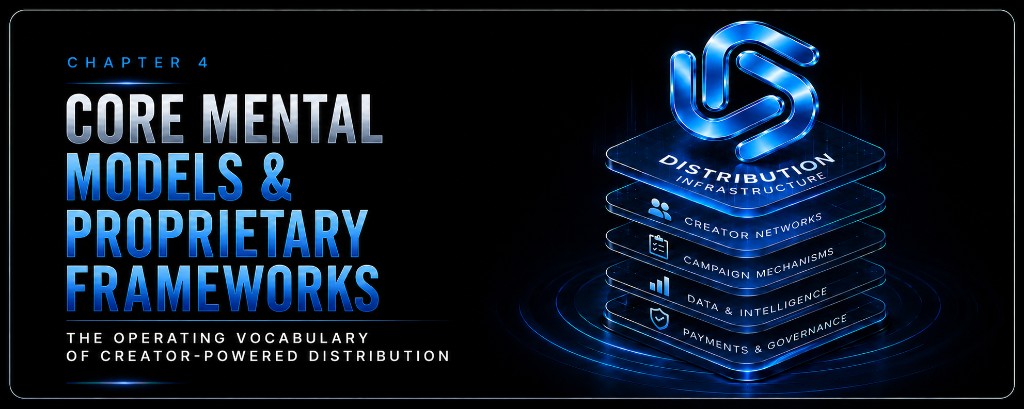
The Distribution Manifesto
Chapter 4 of 11 · 7 min read
Clipping, Clippers, and Distribution
The Three-Part Model
The argument
The industry makes clipping sound more complicated than it needs to be, then makes the operation much simpler than it really is.
I use three words to keep the hierarchy clear:
- Clipping is the mechanism.
- Clippers are the people and accounts that apply judgment, package the content, and create distribution surfaces.
- Distribution is the system that coordinates the mechanism and the people toward a business objective.
Most bad programs collapse all three into “make short videos.” That is how an operator ends up with a folder full of files, dozens of anonymous accounts, and no defensible answer to the question: what did this create for the business?
The distinction matters because each layer fails differently.
- Bad clipping is a source-selection or packaging problem.
- Bad clippers are a talent, incentive, training, or governance problem.
- Bad distribution is a strategy, routing, measurement, or reallocation problem.
If you cannot name the layer that failed, you cannot fix the campaign.
Layer one: Clipping
Clipping is the process of extracting a complete, useful unit from longer source material and packaging that unit for a specific platform and audience.
The word “complete” matters. A clip is not merely a short section of video. It must contain enough context to create an understandable promise, tension, lesson, reaction, demonstration, or story without requiring the viewer to watch the original source first.
Good clipping involves at least five judgments:
- Which moment deserves to become its own asset?
- What context must remain for the moment to be accurate?
- What opening earns attention without misrepresenting the payoff?
- How should pacing, framing, captions, and length change for the target platform?
- What should the viewer understand or do after watching?
Software can help locate moments, transcribe speech, reframe video, remove silence, and generate captions. It cannot make all five judgments reliably across every brand, claim, audience, and platform. That is why pushing a button is not the same thing as clipping professionally.
The simplest measure of clipping productivity is not raw clip count. It is approved distribution yield:
Approved distribution yield = approved, publishable clips / source assets used
Even that number needs context. Ten repetitive clips built from the same sentence may have lower value than three distinct clips aimed at different buyer objections. The goal is useful variation, not multiplication for its own sake.
Layer two: Clippers
A clipper is not just an editor.
The editor produces the asset. The clipper understands that the asset lives inside a distribution job. Depending on the campaign, that job may include selecting the moment, editing it, writing the hook, publishing from an account, adapting it to platform culture, following claim rules, and reporting performance.
A professional clipper creates value through four traits:
- Judgment: selecting moments that can stand alone and matter to the target audience.
- Craft: packaging those moments so the format feels native rather than recycled.
- Reliability: following the brief, meeting deadlines, handling revisions, and documenting the work.
- Integrity: avoiding stolen content, fake engagement, misleading hooks, duplicate submissions, and undisclosed promotional behavior.
Follower count is not one of the four. Reach can help, but a large account with weak fit or poor reliability is often less valuable than a smaller operator who understands the audience and consistently produces approved work.
For a business owner, this changes recruiting. Do not ask only, “Can this person edit?” Ask:
- What platform do they understand deeply?
- Which audience do they already speak to?
- Can they show complete examples rather than highlight reels?
- How do they choose moments?
- What percentage of their submissions are approved?
- Can they follow rights, disclosure, and claim rules?
- Will they still be available in the next campaign?
For someone becoming a clipper, the lesson is direct: competing on software makes you replaceable. Competing on judgment, platform knowledge, quality, and trust makes you valuable.
Layer three: Distribution
Distribution begins where file delivery ends.
A distribution system answers seven questions:
- What business objective are we trying to influence?
- Which source material contains the proof, stories, or ideas capable of influencing it?
- Which clippers and creator accounts can credibly reach the relevant audience?
- Which formats and platforms match the message?
- What behavior will the incentive model reward?
- How will quality, rights, claims, and disclosures be controlled?
- What will the results change about the next allocation of content, creators, and budget?
Without those answers, a company may still receive views. It has not built a repeatable distribution capability.
Distribution also forces the operator to separate four levels of result:
- Output: clips produced, approved, and published.
- Attention: views, watch time, shares, saves, and audience coverage.
- Action: clicks, registrations, inquiries, sales conversations, or other qualified outcomes.
- Capacity: reusable assets, retained clippers, performance history, stronger briefs, and faster future execution.
The last level is easy to ignore because it does not fit inside a social analytics screenshot. It is often the level that makes the next campaign cheaper and more predictable.
The campaign that changed my mind
The campaign that convinced me this was a category—not just a content tactic—was a time-sensitive speculative-asset launch on X.
I am intentionally withholding the client names. The distribution pattern is what matters.
The first part of the launch moved slowly. The final window needed enough coordinated activity to make the story difficult to miss. More than 150 creators were activated in a compressed period. Clips, commentary, and posts converged on the same launch narrative. Internal reporting attributed more than 10 million views to the campaign, while the presale was reported as moving from roughly $300,000 to more than $1.5 million during the broader launch period.
Those numbers require discipline. Distribution did not prove the asset had long-term value. Views did not establish investment merit. The presale movement cannot be attributed to clipping alone. This is not financial advice or an endorsement of the underlying asset.
What the campaign demonstrated was narrower and more useful: coordinated creator activity could change the visibility and velocity of a story inside a short market window. The source content, creators, timing, narrative, and incentive structure behaved as one system.
That was not “we made clips.”
That was distribution.
Evidence note: Figures are drawn from an anonymized Clipur internal campaign report and client-supplied launch reporting. The campaign is presented as an operational example, not proof of financial causation or future performance.
The scam test
When someone says clipping is a scam, ask what they are actually describing.
If the program uses stolen content, fake engagement, undisclosed promotion, misleading edits, low-quality accounts, or invented attribution, the criticism is correct. Those practices are not an edge. They are failure.
If the program produces real source-derived assets, uses capable clippers, distributes through authentic accounts, follows platform and disclosure rules, tracks what it can honestly measure, and improves the next allocation decision, then the word “scam” no longer describes the mechanism. The remaining question is whether the economics make sense.
Use this test:
- Can the operator identify the source rights?
- Can the operator name who produced and published each asset?
- Can the operator explain the incentive model?
- Can the operator separate submitted, approved, published, and rejected output?
- Can the operator distinguish raw views from qualified outcomes?
- Can the operator disclose what is reported, estimated, or not attributable?
- Can the operator show what changed after the campaign?
If the answer is no across most of these, do not scale the program.
How to use the model as a buyer
For the primary reader of this book, the three-part model creates two immediate operating choices.
If you are launching your own campaign: own the objective, source rights, brief, quality rules, measurement definitions, and final budget decision. You may outsource editing or creator recruitment; you cannot outsource accountability.
If you are hiring managed distribution: evaluate the partner on creator quality, cross-platform capacity, approval workflow, reporting honesty, data portability, and what happens after a weak campaign. Do not buy a view package and call it infrastructure.
You should also understand the economics of the people supplying the work, even if you never become one of them.
A professional clipper should choose a platform and audience to understand deeply, then demonstrate moment selection, accuracy, native packaging, and performance—not only flashy editing. An agency should sell only what it can fulfill, begin with a narrow platform and creator-supply advantage, and expand after quality is repeatable.
Those standards matter to the buyer because the campaign will inherit the incentives and limitations of the supply beneath it.
Clipping creates the units. Clippers create the human capacity. Distribution turns both into a business system.
That is the model the rest of the book will operationalize.
Read the whole book
The New Attention Economy: The Distribution Manifesto, 11 chapters, free to read and share.
Related courses
Related Clipipedia terms
Creator-Powered Distribution
Creator-powered distribution is a model where a network of independent creators publishes brand content across their own accounts, multiplying reach far beyond a brand's owned channels.
When you are ready to apply it
Ready to launch a campaign?
Use Clipur to turn existing content into distributed short-form reach.